

Introduction
In the era of precision manufacturing and advanced semiconductor fabrication, material selection has become a decisive factor influencing system accuracy, thermal stability, and long-term reliability. Among low-thermal-expansion ceramic materials, cordierite has emerged as a critical material due to its unique combination of thermal shock resistance, high-temperature stability, oxidation resistance, and balanced mechanical performance.
Cordierite has been widely applied in metallurgy, automotive catalytic substrates, environmental protection systems, electronic packaging, and infrared emission technologies. More importantly, in semiconductor equipment manufacturing, cordierite plays a key role as the core material for reticle stage mirror components in lithography systems, directly impacting positioning accuracy and production efficiency in advanced chip manufacturing.
Core Material Properties of Cordierite
1. Ultra-Low Coefficient of Thermal Expansion
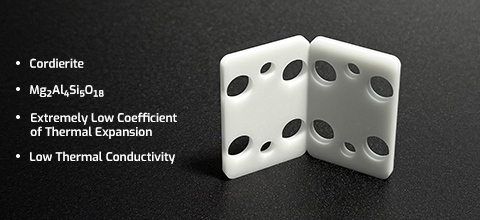
The most distinctive property of cordierite is its exceptionally low coefficient of thermal expansion (CTE), typically ranging from 1.5 × 10⁻⁶ to 4.0 × 10⁻⁶ K⁻¹ from room temperature up to 1000 °C. This value is significantly lower than that of conventional ceramic materials.
This behavior originates from cordierite’s layered crystal structure within a hexagonal crystal system. The ordered arrangement of Mg²⁺, Al³⁺, and Si⁴⁺ ions forms a stable lattice framework. Under thermal excitation, lattice vibrations remain limited, while interlayer interactions effectively buffer thermal stress. As a result, cordierite resists cracking and deformation during rapid temperature fluctuations, ensuring dimensional stability in high-temperature service environments.
2. High-Temperature and Chemical Stability
Cordierite exhibits a melting point of approximately 1460 °C and maintains stable physical and chemical properties during long-term operation below 1200 °C, without significant phase transformation or softening.
In addition, cordierite demonstrates excellent chemical inertness, showing strong resistance to acids, alkalis, salts, and other corrosive media. This makes it suitable for complex and harsh operating environments where chemical stability is essential.
3. Balanced Mechanical and Thermal Properties
Although cordierite has lower hardness than high-strength ceramics such as alumina, it offers good fracture toughness and outstanding thermal shock resistance, allowing it to withstand moderate mechanical impact and rapid temperature changes.
Its relatively low thermal conductivity further enables cordierite to function as both a structural material and a thermal insulation component, particularly in high-temperature insulation applications where dimensional stability is critical.
Applications of Cordierite in Semiconductor Equipment
The resolution and throughput of lithography systems are highly dependent on the positioning accuracy of ultra-precision motion stages. As a critical component of the positioning system, reticle stage mirror assemblies impose extremely stringent material requirements:
- Coefficient of thermal expansion ≤ 2 × 10⁻⁸ K⁻¹, ensuring negligible dimensional drift under thermal variation
- Flexural strength > 190 MPa and elastic modulus > 140 GPa, combined with sufficiently low density to support high-speed motion
Thanks to its ultra-low thermal expansion and well-balanced mechanical properties, cordierite ceramics meet these demanding requirements and have become one of the most suitable materials for mirror-stage components in advanced lithography systems.
Manufacturing of High-Precision Cordierite Components
Transforming cordierite powder into high-precision mirror components requires a tightly controlled, multi-stage manufacturing process.
First, high-purity, fine-grained, and compositionally homogeneous cordierite powders must be prepared. This step is fundamental to achieving dense ceramics during sintering. Subsequently, forming processes such as uniaxial dry pressing and cold isostatic pressing are employed to shape green bodies, with precise control over pressure and tooling parameters to ensure dimensional consistency.
The green bodies then undergo high-temperature sintering, during which temperature profiles, atmosphere, and dwell time are strictly controlled to promote densification and phase development. Finally, precision machining and polishing are performed to achieve the surface roughness and geometric accuracy required by lithography equipment.
Key Technical Factors: Particle Size Control and Homogeneous Mixing
The performance of cordierite ceramics is highly sensitive to powder particle size and compositional uniformity.
- Ultrafine powders with particle sizes below 50 nm significantly enhance sintering activity, enabling densification at lower temperatures while reducing internal porosity and defects. This improves mechanical strength, fracture toughness, and microstructural uniformity.
- Uniform elemental distribution prevents localized compositional deviations during sintering, ensuring consistent thermal expansion behavior and mechanical performance.
These factors are particularly critical for semiconductor equipment, where even minimal dimensional instability can affect system accuracy and yield.
Market Landscape and Domestic Development
In the market for low-thermal-expansion materials, cordierite demonstrates notable advantages compared with traditional glass-ceramics such as Zerodur. Specifically, cordierite offers:
- Approximately 55% higher elastic modulus
- Only slightly higher density
- Thermal conductivity nearly three times greater, enabling improved heat dissipation and thermal stability
Internationally, leading companies such as ASML, Nikon, and Canon continue to increase investment in cordierite-based materials. Japanese manufacturers including Kyocera and Hitachi have successfully applied cordierite ceramics in lithography stage platforms.
In China, cordierite research and industrialization started later and remains at the pilot-scale development stage. However, national programs such as the “Very Large Scale Integrated Circuit Manufacturing Equipment and Process” initiative are accelerating localization efforts, aiming to reduce dependence on imported high-end semiconductor materials.
Future Development and Technical Challenges
The primary technical challenge for next-generation cordierite materials lies in further reducing the CTE to meet EUV lithography requirements of ≤ 2 × 10⁻⁸ K⁻¹. While the gap between conventional cordierite (≈10⁻⁶ K⁻¹) and EUV requirements is substantial, ongoing advances in process optimization and elemental doping make this target achievable.
Conclusion
As semiconductor manufacturing continues toward higher precision and domestic localization, cordierite ceramics are steadily breaking international monopolies and gaining strategic importance. With continued advancements in materials engineering and process control, cordierite is poised to play an increasingly critical role not only in semiconductor equipment, but also across the broader landscape of global precision manufacturing.