





CordieriteMg₂Al₄Si₅O₁₈
Cordierite
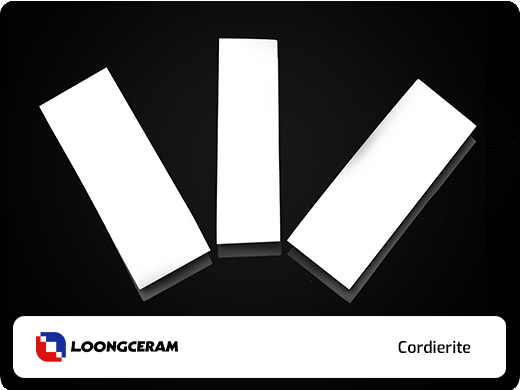
Cordierite is a magnesium aluminosilicate mineral with the ideal chemical formula Mg₂Al₄Si₅O₁₈. The most core physical properties of this material lie in its extremely low coefficient of thermal expansion (CTE) and exceptional thermal shock resistance. This enables it to maintain high dimensional stability and structural integrity under rapid thermal cycling and high-temperature environments.
Jump to
Material Advantages
- Extremely Low Coefficient of Thermal Expansion Cordierite has a CTE of only about 0.5-1.0×10⁻⁶/°C within the range of 20-800°C, which is far lower than that of ordinary ceramics. The small volume change and low stress induced by sudden temperature changes result in superior “thermal shock” resistance, avoiding the risk of material cracking.
- Low Thermal Conductivity Its thermal conductivity at room temperature is approximately 1.5-3 W/(m·K), providing good insulation capabilities. This characteristic makes it suitable for use as a thermal barrier material.
- Excellent Mechanical Properties Cordierite has a Mohs hardness of 7-7.5 and a high elastic modulus (100-120 GPa), enabling it to effectively resist deformation and enhance dimensional stability.
- High-Temperature Stability The refractoriness of cordierite is about 1460°C. When used for long periods in high-temperature environments below 1200°C, it does not soften, melt, or undergo crystal structure decomposition. It can withstand short-term instantaneous high temperatures of 1300-1400°C while maintaining structural integrity.
- Chemical Stability It possesses high chemical stability. When used in automotive exhaust treatment, it does not react with acidic substances in the exhaust gas nor interact with the catalyst.
| Performance | Unit | 2MgO·2Al2O3·5SiO2 | Testing Standards | |
| Mechanical Properties | Density | g/cm³ | 2.49 | JIS R 1634 |
| Colour | – | White | – | |
| Water absorption | % | 0 | JIS C 2141 | |
| Vickers hardness HV9.807N | GPa | 8 | JIS R 1610 | |
| Flexural strength 3 P.B. | MPa | 191 | JIS R 1601 | |
| Compressive strength | MPa | 1,800 | JIS R 1608 | |
| Compressive strength | GPa | 140 | JIS R 1602 | |
| Poisson’s ratio | – | 0.31 | ||
| Fracture toughness (SEPB) | MPa·m¹/² | 1–1.5 | JIS R 1607 | |
| Thermal Properties | Thermal expansion coefficient | 50℃~300℃(x10⁻3) | 0.23 | JIS R 1618 |
| 50℃~900℃(x10⁻3) | 1.41 | |||
| Coeffi cient of linear thermal expansion | 50℃~450℃(×10⁻⁶/K) | 0.76 | ||
| 50℃~900℃(×10⁻⁶/K) | 1.12 | |||
| Thermal conductivity | W/(m·K) | 4 | JIS R 1611 | |
| Specifi c heat capacity | J/(g·K) | 0.71 | ||
| Thermal shock temperature diff erence | ℃ | 450 | JIS R 1648 | |
| Electrical properties | Dielectric strength | kV/mm | 19.1 | JIS C 2141 |
| Volume resistivity | 20℃/Ω·cm | >1014 | ||
| 300℃/Ω·cm | >1012 | |||
| 500℃/Ω·cm | >1010 | |||
| Dielectric constant(1MHz) | – | 4.9 | ||
| Dielectric loss angle(1MHz) | ×10⁻⁴ | 9 | ||
| Loss factor | ×10⁻⁴ | 30 |
Typical Applications
- Semiconductor Industry Cordierite has a CTE of only about 0.5-Due to its low CTE, high elastic modulus, and low dielectric constant, cordierite ceramic finds wide application in semiconductor manufacturing. It can be used for components such as wafer stages, mirror substrates, wafer handling mechanisms, and electrostatic chucks in lithography systems. Components made from cordierite can effectively suppress deformation caused by temperature variations in the thermal field during application, achieving precise positioning functions. Furthermore, they can maintain stable physical and mechanical properties at high temperatures up to 1200°C, enabling high-temperature applications that materials like glass-ceramics cannot satisfy.
- Aerospace Applications Cordierite not only has an extremely low CTE (which can reach 0 ± 20 ppb/°C at 22°C) but also boasts high specific stiffness (E/ρ) and good thermal conductivity. This ensures structural lightweighting while allowing rapid temperature equalization, avoiding thermal gradient deformation.
- The comprehensive performance of cordierite surpasses that of traditional glass-ceramics, making it one of the preferred materials for a new generation of space optical systems. Its properties, including dimensional stability, radiation resistance, thermal conductivity, and specific stiffness, are superior to those of traditional low-expansion glass-ceramics.
- Automotive Industry Owing to its low CTE, excellent thermal stability, good mechanical strength, and chemical inertness, cordierite is a core material in the automotive industry for engine exhaust systems and thermal management applications, particularly as the key material for “catalytic substrates” in modern automotive exhaust treatment.
- The cordierite “honeycomb” structure contains thousands of parallel microchannels. When coated with a high-surface-area γ-Al₂O₃ layer and finally loaded with precious metal catalysts such as platinum, palladium, and rhodium, it enables effective purification of automotive exhaust gases.