

Introduction: Why Wear Problems Lead Engineers to Technical Ceramics
In industrial systems, wear is rarely a sudden failure mechanism. Instead, it is a progressive and predictable degradation process that directly affects equipment lifetime, maintenance frequency, and operational stability.
In applications such as bulk material handling, chemical processing, pump and valve systems, and precision equipment, conventional metallic materials often reach their limits under conditions involving high hardness particles, elevated temperatures, corrosive media, or continuous sliding contact.
Technical ceramics have emerged as a practical engineering solution in these environments—not because of surface treatments or coatings, but due to their intrinsic material properties.
1. What Are Technical Ceramics for Wear-Resistant Applications?
Technical ceramics (also referred to as advanced or engineering ceramics) are high-purity inorganic materials manufactured through controlled powder processing and sintering.
When used for wear-resistant industrial components, technical ceramics typically exhibit:
- High hardness and abrasion resistance
- Excellent chemical and thermal stability
- Minimal plastic deformation under load
- Stable performance without surface coatings
Unlike hardened metals, their wear resistance is not dependent on surface conditions but is inherent to the bulk material.
2. Material Mechanisms Behind Ceramic Wear Resistance
2.1 Hardness and Resistance to Abrasive Wear
Wear processes such as abrasion and erosion are driven by local plastic deformation, micro-cutting, or fatigue.
In technical ceramics:
- Strong ionic and covalent bonds limit dislocation motion
- Crystal lattices remain stable under high contact stress
As a result, ceramic materials tend to resist penetration and cutting, rather than deforming as metals do.
2.2 Microstructure Control and Wear Behavior
Hardness alone does not determine wear performance. From an engineering perspective, wear resistance is strongly influenced by:
- Grain size and grain boundary characteristics
- Residual porosity and pore distribution
- Secondary phases at grain boundaries
Well-controlled sintering processes produce uniform microstructures, which are critical for stable and predictable wear behavior over long service periods.
3. Common Technical Ceramics Used in Wear-Resistant Components
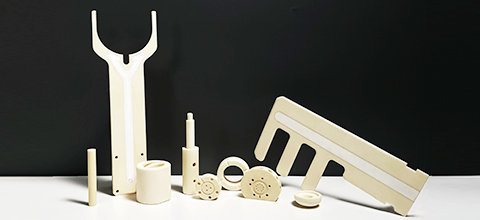
3.1 Alumina Ceramics (Al₂O₃)
- High hardness and good cost-performance balance
- Excellent resistance to abrasive wear
- Widely used in liners, guide components, and sealing elements
High-purity alumina remains the baseline material for many industrial wear applications.
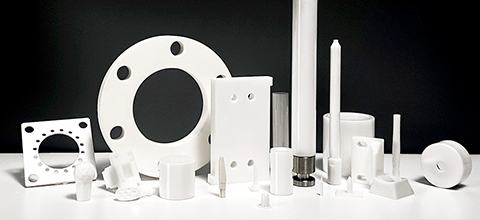
3.2 Zirconia and Zirconia-Toughened Ceramics (ZrO₂ / ZTA)
- Transformation toughening improves crack resistance
- Better tolerance to impact and cyclic loading
- Suitable for wear environments involving both abrasion and mechanical stress
Zirconia-based ceramics are often selected where wear resistance must be combined with structural reliability.
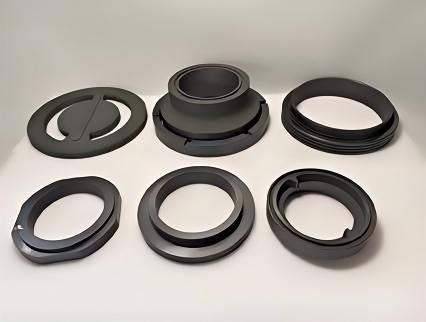
3.3 Silicon Carbide Ceramics (SiC)
- Extremely high hardness and stiffness
- Outstanding resistance to abrasion and chemical attack
- Stable performance at elevated temperatures
Silicon carbide is frequently chosen for severe wear conditions, including mining, chemical processing, and energy systems.
4. Typical Industrial Applications of Wear-Resistant Ceramic Components
4.1 Bulk Material Handling and Powder Processing
- Chutes and transfer elbows
- Pipe linings
- Dosing and feeding components
Ceramic components significantly reduce wear rates and extend maintenance intervals.
4.2 Pump, Valve, and Fluid Control Systems
- Shaft sleeves
- Seal rings
- Valve seats and plungers
4.3 Precision and High-End Equipment
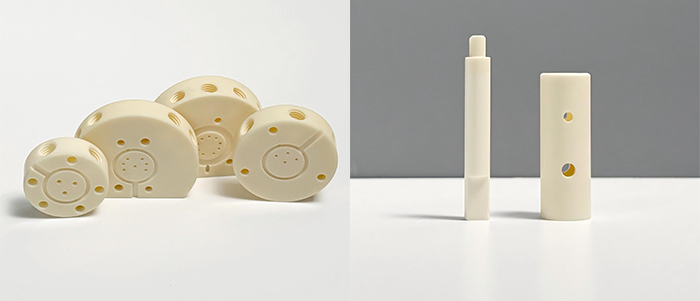
In semiconductor and advanced manufacturing equipment, wear debris control is critical.
Technical ceramics are valued not only for durability, but also for predictable and low-contamination wear behavior.
5. Influence of Sintering Processes on Wear Performance
The final wear performance of ceramic components depends heavily on the sintering route:
- Pressureless sintering: suitable for complex shapes and large-scale production
- Hot pressing: improves density and microstructural uniformity
- Hot isostatic pressing (HIP): eliminates residual closed porosity and enhances long-term reliability
From an engineering standpoint, material selection and sintering strategy must be evaluated together.
6. Engineering Criteria for Selecting Wear-Resistant Ceramic Components
Effective material selection requires a clear understanding of:
- Dominant wear mechanism (abrasion, sliding, erosion)
- Presence of impact or cyclic loading
- Operating temperature and chemical environment
- Dimensional tolerance and component geometry
In wear-critical applications, the optimal solution is not necessarily the hardest material, but the one that delivers stable, predictable performance under real operating conditions.
Conclusion: The Engineering Value of Wear-Resistant Technical Ceramics
Technical ceramics used in wear-resistant industrial components represent a shift from reactive maintenance to materials-driven reliability engineering.
Through appropriate material choice, microstructural control, and sintering optimization, ceramic components can provide long service life, reduced downtime, and predictable performance in demanding industrial environments.
For engineers focused on system stability and lifecycle cost, technical ceramics are no longer niche materials—they are established, rational engineering solutions.
Just tell me the next step.