

Introduction
In modern high-end manufacturing and advanced packaging systems, operating conditions increasingly involve high temperatures, rapid thermal cycling, strong radiation, mechanical shock, and corrosive atmospheres. Traditional metallic materials often fail in such extreme environments due to thermal expansion mismatch, corrosion attack, thermal-shock-induced cracking, or structural degradation.To overcome these limitations, engineers are turning toward composite ceramic materials, including fiber-reinforced ceramics, particle-reinforced ceramics, ceramic–metal hybrids, and multilayer ceramic structures. These materials combine the inherent advantages of ceramics—high temperature resistance, corrosion resistance, chemical stability, and hardness—with enhanced toughness, thermal-shock resistance, and fatigue life brought by composite architectures.
1. Structure and Mechanisms of Composite Ceramics
1.1 Definition and Categories
Composite ceramic materials typically consist of a ceramic matrix reinforced by:
- Fibers (SiC fibers, carbon fibers, alumina fibers)
- Particles (SiC, ZrB₂, TiB₂, etc.)
- Multiphase ceramic combinations
- Ceramic–metal hybrids or ceramic coatings on metallic substrates
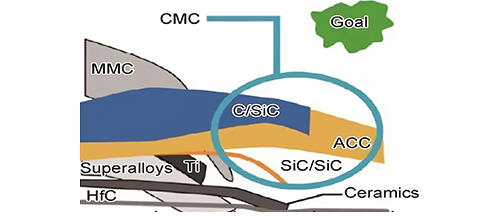
A representative class is Ceramic Matrix Composites (CMC), which utilize mechanisms such as:
- Fiber bridging
- Fiber pull-out and crack deflection
- Controlled interfacial debonding
- Multi-phase stress distribution
These mechanisms effectively compensate for the inherent brittleness of monolithic ceramics.
1.2 Failure Mechanisms in Extreme Environments
- Rapid temperature fluctuations (thermal shock)
- Continuous high-temperature operation (>1000°C)
- Strong oxidation or corrosive media
- Radiation exposure
- Mechanical fatigue, shock, and vibration
Typical failure modes:
- Crack initiation and propagation due to thermal or mechanical stress
- Phase transformation or oxidation leading to microstructural degradation
- Accumulated microcracks under thermal cycling
- Interfacial delamination in composite structures
Composite ceramics address these issues through:
- Fiber/particle reinforcement to bridge and slow crack growth
- High-temperature ceramic matrices to maintain structural integrity
- Engineered interphases (carbon, BN, boride coatings) to deflect cracks
- Multi-phase architectures to match thermal expansion and reduce stress
2. Key Performance Drivers of Composite Ceramics
When selecting composite ceramics for extreme environments, engineers should evaluate the following core performance dimensions:
2.1 High-Temperature Capability
- Many composite ceramics retain strength at 1000–2000°C (e.g., UHTC systems).
- Reduces cooling requirements and enables lightweight thermal structures.
- Essential for aerospace, turbine engines, and semiconductor thermal modules.
2.2 Thermal Shock and Thermal Cycling Durability
- Fiber-reinforced architectures prevent catastrophic cracking.
- Interfacial sliding and crack deflection improve thermal cycling lifetime.
- Suitable for applications involving repeated heat loads or rapid temperature swings.
2.3 Mechanical Strength and Toughness
- Composite ceramics significantly increase fracture toughness versus monolithic ceramics.
- Important for high-load packaging housings, thermal plates, and structural components.
- Provides vibration resistance and accommodates thermal-mechanical stresses.
2.4 Corrosion and Chemical Resistance
Extreme environments often involve:
- Molten salt
- High-temperature oxidizing gases
- Plasma and reactive species
- Chemical by-products in energy or semiconductor applications
Composite ceramics can incorporate oxidation-resistant phases or protective coatings to enhance reliability.
2.5 Thermal-Physical Properties
For thermal management applications:
- Thermal conductivity must be engineered (higher for heat spreaders, lower for insulators)
- CTE matching is critical to prevent delamination
- Multi-phase design enables control of heat flow and stress distribution
3. Representative Composite Ceramic Systems
| Material System | Density (g/cm³) | Continuous Service Temp (°C) | Fracture Toughness (MPa·m¹/²) | Typical Features & Applications |
|---|---|---|---|---|
| SiC/SiC | 2.5–3.0 | 1200–1500 | 10–30 | Jet turbine blades, aerospace brake disks |
| Oxide/Oxide CMC | 2.7–3.8 | 1000–1200 | 6–15 | Thermal protection systems, chemical equipment |
| C/SiC | 2.0–2.3 | 1000–1400 (lower in oxidation) | 15–25 | Hypersonic aircraft, high-speed braking systems |
| Al₂O₃ Composites | 3.6–3.9 | 1000–1200 | 4–10 | Electronic packaging, wear-resistant components |
These composite systems enable applications requiring high mechanical reliability, reduced weight, and elevated-temperature operation.
4. Application Scenarios in Extreme Environments
4.1 Semiconductor Packaging & Thermal Management Systems
Composite ceramics are increasingly used in high-power semiconductors and advanced IC packaging due to:
- High temperature stability (preventing metal softening or fatigue)
- Optimized heat dissipation paths through multi-phase structures
- Low CTE mismatch between ceramic layers and chips
- Corrosion and oxidation resistance inside vacuum or plasma equipment
Applications include:
- High-power module housings
- CMC-based thermal spreaders
- Ceramic-metal hybrid packaging shells
- High-temperature heat sinks
4.2 Aerospace and High-Temperature Propulsion Systems
Temperatures in this sector can exceed 2000°C. Composite ceramics are used in:
- Thermal protection systems (TPS)
- Re-entry vehicle shields
- Hypersonic flight structures
- Turbine nozzle guide vanes
- High-temperature heat transfer assemblies
CMC and UHTC materials provide an unmatched combination of thermal capability and structural stability.
4.3 Energy and Harsh-Environment Manufacturing Systems
Applications include:
- Molten-salt reactors
- Carbon capture systems
- Fusion reactors
- High-radiation environments
- Chemical processing reactors
Benefits:
- Long-term corrosion resistance
- Radiation stability
- High mechanical fatigue life
- Resistance to pressure spikes and thermal gradients
Conclusion
Composite ceramic materials are rapidly transitioning from research topics to practical engineering solutions across semiconductor, aerospace, and energy industries. Through fiber reinforcement, particle strengthening, multi-phase architectures, and engineered interfaces, they overcome limitations of traditional ceramics and metals in extreme environments.With their exceptional high-temperature performance, thermal shock resistance, chemical inertness, and tunable thermal-mechanical properties, composite ceramics are becoming indispensable for next-generation high-performance systems.