

Introduction: Why Alumina Density Matters in Engineering Design
In advanced ceramic engineering, alumina density is not merely a physical parameter listed in a datasheet. It directly influences mechanical strength, thermal conductivity, dielectric behavior, and long-term reliability of ceramic components.For engineers working in semiconductor equipment, electronics packaging, precision machinery, and high-temperature systems, understanding how alumina density varies with purity and manufacturing route is essential for correct material selection.This article provides a technical yet readable explanation of alumina density, structured around material properties, manufacturing mechanisms, and density differences across purity grades.
1. Properties of Alumina Ceramic Related to Density
1.1 What Is Alumina Ceramic?
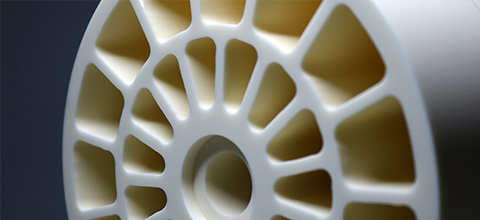
Alumina ceramic is a technical ceramic primarily composed of aluminum oxide (Al₂O₃). It crystallizes in the corundum structure, characterized by strong ionic–covalent bonds and high lattice stability.
The theoretical density of pure α-alumina is approximately 3.98 g/cm³, but practical alumina ceramics typically exhibit lower bulk density due to controlled porosity and processing constraints.
1.2 Why Density Is a Key Material Parameter
Alumina density affects multiple functional properties:
- Mechanical strength: Higher density usually correlates with fewer pores and higher flexural strength
- Thermal conductivity: Dense alumina allows more efficient phonon transport
- Electrical insulation: Reduced porosity improves dielectric strength
- Chemical resistance: Dense microstructures limit penetration of corrosive media
In engineering terms, density reflects the degree of microstructural consolidation, not just mass per unit volume.
1.3 Density vs. Porosity Relationship
Alumina ceramics are inherently brittle materials. Even small levels of residual porosity can act as stress concentrators. As a result:
- High-density alumina is favored for structural and load-bearing components
- Lower-density alumina may be acceptable for thermal insulation or non-critical parts
This trade-off is intentional and application-driven.
2. Alumina Manufacturing Processes and Their Impact on Density
2.1 Raw Powder Characteristics
The starting alumina powder strongly influences final density:
- Particle size distribution
- Phase purity (α-alumina vs. transition alumina)
- Agglomeration behavior
High-purity, fine, and well-dispersed powders enable higher green density and improved sintering efficiency.
2.2 Forming Methods
Different forming processes lead to different green densities, which directly affect final alumina density.
Common forming methods include:
- Dry pressing: Moderate green density, cost-effective
- Cold isostatic pressing (CIP): Uniform density distribution
- Slip casting: Suitable for complex shapes
- Tape casting: Used for thin substrates
Uniform green density is critical to avoiding differential shrinkage and residual porosity.
2.3 Sintering and Densification Mechanisms
Sintering is the primary step where alumina density is established.
Key factors influencing densification include:
- Sintering temperature and dwell time
- Grain growth control
- Additives such as MgO for grain boundary stabilization
Typical sintering temperatures for alumina range from 1550°C to 1750°C. Insufficient sintering results in incomplete densification, while excessive grain growth can degrade mechanical properties despite high density.
2.4 Post-Sintering Treatments
Advanced applications may require:
- Hot isostatic pressing (HIP) for near-theoretical density
- Precision grinding and polishing to remove surface flaws
These steps are often used in semiconductor and optical-grade alumina components.
3. Density of Alumina at Different Purity Levels
3.1 Why Purity Affects Alumina Density
Alumina purity influences density through:
- Secondary phase formation
- Liquid-phase sintering behavior
- Grain boundary chemistry
Higher purity alumina generally achieves higher final density and more stable microstructures, but at increased cost.
3.2 Typical Density Values by Alumina Purity
| Alumina Purity | Typical Density (g/cm³) | Key Characteristics |
|---|---|---|
| 92% Al₂O₃ | 3.6 – 3.7 | Cost-effective, moderate strength |
| 95% Al₂O₃ | 3.7 – 3.8 | Balanced performance |
| 96% Al₂O₃ | 3.75 – 3.85 | Widely used in industrial ceramics |
| 99% Al₂O₃ | 3.85 – 3.90 | High insulation, better thermal properties |
| 99.5%+ Al₂O₃ | 3.90 – 3.95 | Semiconductor and precision applications |
These values are representative ranges; actual density depends on processing control and sintering quality.
3.3 Density vs. Cost Considerations
While higher purity alumina offers higher density and improved properties, it is not always the optimal choice. Engineers must consider:
- Whether maximum density is functionally required
- Cost sensitivity of the application
- Risk tolerance for mechanical failure
In many industrial systems, 95–96% alumina provides sufficient density at a lower total cost of ownership.
4. Application Implications of Alumina Density
- Semiconductor equipment: High-density alumina ensures dimensional stability and plasma resistance
- Electrical insulation: Dense alumina improves dielectric breakdown strength
- Wear components: Reduced porosity enhances abrasion resistance
- Thermal management: Density influences heat dissipation efficiency
At Loongeram, alumina density is controlled as part of a broader application-driven material design strategy, rather than optimized in isolation.
Conclusion
Alumina density is not a fixed number but the outcome of material purity, powder quality, forming method, and sintering control.
For engineers, the key takeaway is clear:
- Density should be evaluated in context, not in isolation
- Higher density is beneficial, but only when aligned with application demands