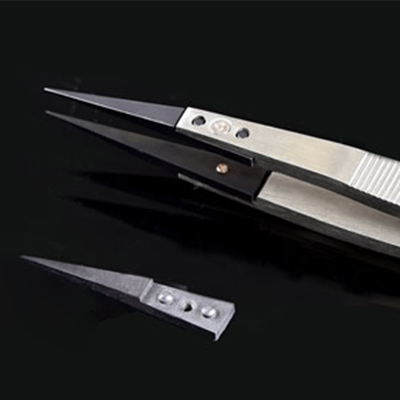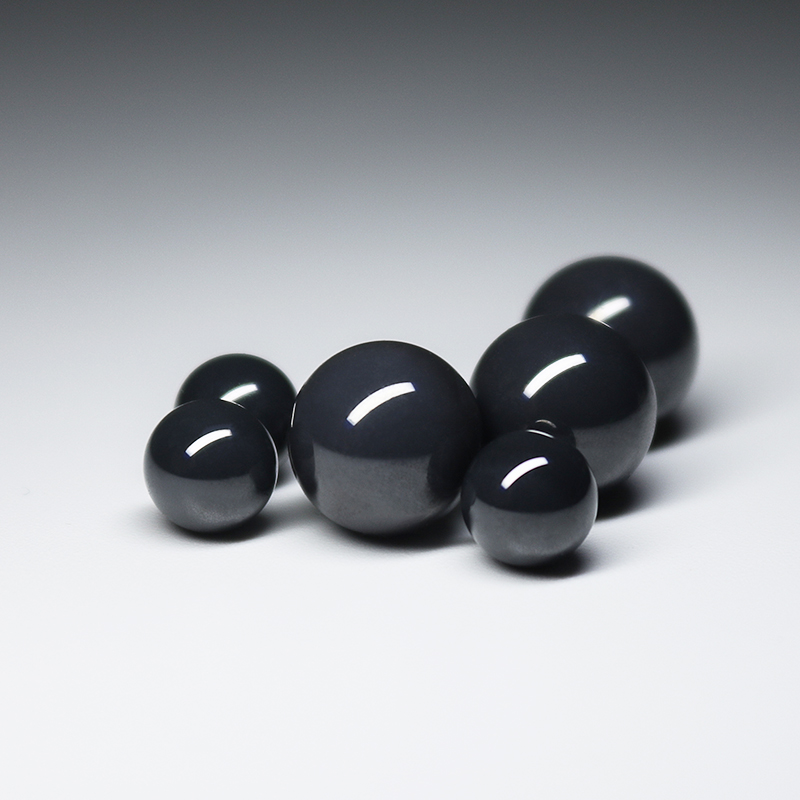


1. Introduction
Zirconia Toughened Alumina (ZTA) is a class of advanced composite ceramic materials comprising primarily alumina (Al₂O₃) reinforced with dispersed particles of zirconia (ZrO₂). By combining the high hardness and chemical stability of alumina with the transformation toughening mechanism of zirconia, ZTA ceramics achieve a unique balance of mechanical strength, fracture toughness, wear resistance, and thermal stability that neither pure alumina nor pure zirconia can provide alone.
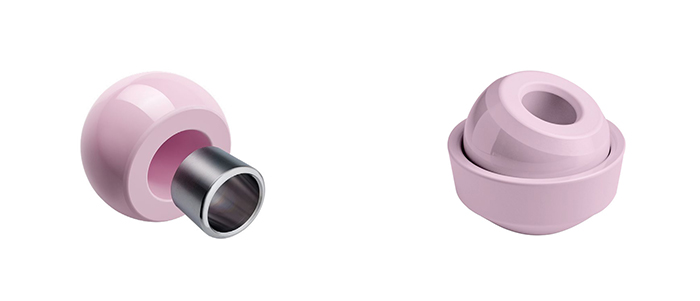
2.Material Properties of ZTA
2.1 Composite Structure and Toughening Mechanism
ZTA is fundamentally a composite ceramic, typically containing 10–30 wt% of zirconia evenly dispersed within an alumina matrix.
- Alumina (Al₂O₃) provides:
- High hardness and wear resistance
- Chemical and thermal stability
- Zirconia (ZrO₂) adds:
- Transformation toughening
- Increased fracture resistance
- Enhanced mechanical reliability
The enhanced toughness in ZTA arises from the stress-induced transformation toughening mechanism:
- Upon mechanical stress (e.g., at a crack tip), tetragonal ZrO₂ grains transform into the monoclinic phase, producing a slight volume expansion.
- This localized expansion generates compressive stresses that resist crack propagation.
This process improves fracture toughness significantly over monolithic alumina.
2.2 Mechanical and Physical Properties
A representative set of performance metrics for ZTA ceramics demonstrates the synergy of alumina and zirconia:
| Property | Typical ZTA | Monolithic Alumina | Monolithic Zirconia |
|---|---|---|---|
| Density (g/cm³) | 4.1–4.18 | ~3.9 | ~6.0 |
| Hardness (Vickers) | 16–21.5 GPa | ~18 GPa | ~12 GPa |
| Fracture Toughness (K_IC) | ~6–10 MPa·m¹ᐟ² | ~3–4 MPa·m¹ᐟ² | ~9–12 MPa·m¹ᐟ² |
| Flexural Strength (MPa) | ~600–850 | ~400–600 | ~900–1200 |
| Young’s Modulus (GPa) | ~335–350 | ~380 | ~200 |
| Thermal Conductivity | ~20 W/m·K | ~30 W/m·K | ~2–3 W/m·K |
| Max Service Temp | ~1500 °C | ~1700 °C | ~1000 °C |
ZTA’s performance metrics highlight:
- Higher toughness and impact resistance than pure alumina.
- Comparable strength with improved wear resistance.
- Lower thermal conductivity than alumina alone, but acceptable for many high-temperature structural applications.
2.3 Thermal and Chemical Stability
ZTA retains structural integrity at elevated temperatures (~1500 °C) and exhibits good corrosion resistance in acidic and alkaline environments. Its thermal shock resistance is improved by the composite microstructure, making it suitable for components subjected to rapid temperature changes.
3. ZTA Manufacturing and Processing
The performance of ZTA ceramics is directly influenced by powder processing, mixing, forming, and sintering technologies.
3.1 Powder Preparation and Composition Control
A typical ZTA composition uses a high-purity alumina matrix with 10–30 wt% zirconia. The zirconia phase must be well-dispersed to ensure optimal transformation toughening and to control grain growth during densification.
In some research, nano-structuring of starting powders enhances the mechanical properties by refining microstructures and enabling finer grain boundaries.
3.2 Forming Technique
ZTA components can be formed using:
- Dry pressing
- Isostatic pressing
- Injection molding
- Slip casting (for complex geometries)
Achieving uniform green density is essential to avoid differential shrinkage and internal stress formation during sintering.
3.3 High-Temperature Sintering and Densification
ZTA is densified through high-temperature sintering, often followed by Hot Isostatic Pressing (HIP) to achieve near-theoretical density with minimized porosity.
Controlling sintering parameters and phase proportions ensures an optimized balance between dense microstructure and toughening performance, which is central to good fracture toughness and wear resistance.
3.4 Machining and Tolerance Control
Once sintered, ZTA components can be machined at various states:
- Green or bisque machining for rough shaping (before full densification).
- Diamond tool grinding on fully dense ceramics for precision tolerances.
Due to the high hardness and fracture toughness, precision grinding requires robust diamond tooling and controlled processes, increasing manufacturing complexity but enabling tight dimensional control.
4. Industrial Applications of ZTA Ceramics
ZTA’s combined property set — hardness, toughness, wear resistance, and thermal stability — enables wide application across engineering domains:
4.1 Engineering and Wear-Resistant Components
ZTA is used in:
- Ball and seat components for high-pressure valves
- Rollers and guides for metal forming
- Pump seals and pistons
- Cutting tools and grinding media
Its fracture toughness and wear resistance support sustained performance in abrasive environments.
4.2 Industrial Structural Applications
Due to its mechanical reliability, ZTA is incorporated in:
- Bushings and bearings under high load
- Thread and wire guides
- Deep well valves and seats
The phase transformation toughening mechanism enhances impact and vibration resistance.
4.3 Precision Engineering and Electronics
ZTA’s dimensional stability and electrical insulation properties make it suitable for:
- Insulators and substrates
- Electronic packaging components subject to mechanical stress and thermal cycling
- Sensor housings in harsh conditions
4.4 Biomedical and Specialized Use Cases
While outside traditional industrial scope, ZTA’s toughness and wear resistance have also been explored in biomedical applications such as orthopedic implants and dental components.
5. Engineering Q&A (SEO-Friendly)
Q1: What is Zirconia Toughened Alumina (ZTA)?
ZTA is a composite ceramic combining alumina and zirconia phases to provide enhanced mechanical performance and toughness compared to pure alumina or zirconia.
Q2: How does transformation toughening work in ZTA?
Under stress, metastable zirconia particles transform from tetragonal to monoclinic, creating volume expansion that compresses crack tips and impedes crack growth.
Q3: Why is ZTA superior to monolithic alumina?
ZTA exhibits higher fracture toughness, improved impact resistance, and better wear performance than alumina alone due to the zirconia phase.
Q4: How is ZTA manufactured?
Manufacturing involves powder processing, forming (pressing or injection molding), and high-temperature sintering often coupled with HIP to achieve near-full density.
Q5: What industries use ZTA ceramics?
ZTA is used in mechanical wear parts, valves, bearings, precision hardware, electronic insulators, and even biomedical implants.
Q6: Are ZTA ceramics resistant to corrosion and thermal shock?
Yes, ZTA provides good chemical stability and enhanced thermal shock resistance compared with pure alumina, due to fine-grained composites and residual stresses.
Q7: How does phase distribution affect ZTA performance?
Uniform dispersion and controlled size of zirconia particles optimize transformation toughening and prevent premature crack propagation, improving reliability.
Conclusion
Zirconia Toughened Alumina (ZTA) represents a strategically engineered ceramic composite that bridges the performance gaps of alumina and zirconia. Featuring transformation toughening, enhanced fracture resistance, and robust wear behavior, ZTA is increasingly adopted in applications demanding balanced mechanical and thermal performance under stress.