

1. Why Material Selection Between Alumina and Zirconia Matters
In advanced engineering applications, selecting between alumina (Al₂O₃) and zirconia (ZrO₂) is rarely a question of “which is better,” but rather which material aligns with the dominant failure mode, operating environment, and lifecycle expectations.
Both alumina ceramic and zirconia ceramic are widely used across semiconductor equipment, medical devices, precision mechanics, and industrial wear components. However, their mechanical behavior, thermal response, and reliability mechanisms differ fundamentally.
This article provides a selection-oriented, engineering-driven comparison, not a superficial property listing.
2. What Is Alumina Ceramic?
2.1 Chemical Composition and Structure
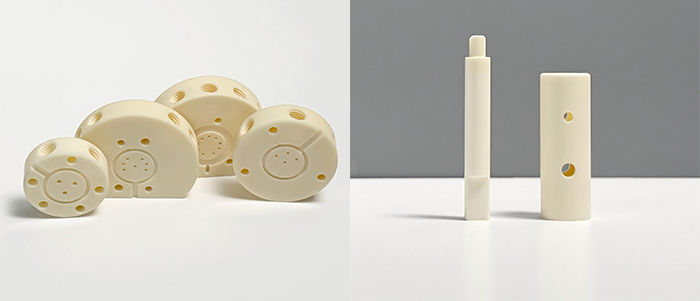
Alumina ceramic is primarily composed of aluminum oxide (Al₂O₃), typically with purity levels ranging from 92% to 99.9%, depending on the application.
Alumina crystallizes in the corundum structure, which is characterized by:
- Strong ionic–covalent bonding
- High lattice stability
- Excellent chemical inertness
This structure explains alumina’s high hardness, wear resistance, and thermal stability, making it one of the most widely adopted technical ceramics.
2.2 Key Characteristics of Alumina Ceramic
- High hardness and abrasion resistance
- Excellent electrical insulation
- Good high-temperature stability
- Relatively low cost and mature processing routes
Alumina is often selected when mechanical wear, electrical insulation, and cost control are primary concerns.
3. What Is Zirconia Ceramic?
3.1 Chemical Composition and Phase Behavior
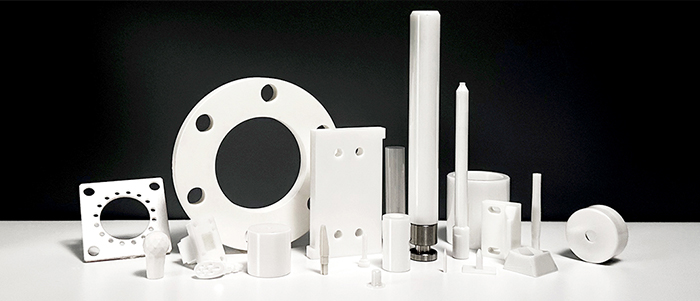
Zirconia ceramic is based on zirconium dioxide (ZrO₂) and is typically stabilized with yttria (Y₂O₃), forming yttria-stabilized zirconia (YSZ).
Unlike alumina, zirconia exhibits temperature-dependent phase transformations (monoclinic, tetragonal, cubic). Controlled stabilization enables a phenomenon known as transformation toughening, which dramatically improves fracture resistance.
3.2 Key Characteristics of Zirconia Ceramic
- Exceptionally high fracture toughness
- High flexural strength
- Good wear resistance under impact loading
- Lower thermal conductivity
Zirconia is often chosen where impact resistance, crack resistance, or mechanical reliability under stress is critical.
4. Property Comparison: Alumina vs. Zirconia Ceramic
| Property | Alumina Ceramic | Zirconia Ceramic |
|---|---|---|
| Chemical Formula | Al₂O₃ | ZrO₂ (stabilized) |
| Density | ~3.8–3.9 g/cm³ | ~6.0 g/cm³ |
| Flexural Strength | 300–400 MPa | 800–1200 MPa |
| Fracture Toughness | 3–4 MPa·m¹ᐟ² | 7–10 MPa·m¹ᐟ² |
| Hardness | Very high | High |
| Thermal Conductivity | Moderate | Low |
| Electrical Insulation | Excellent | Good |
| Cost Level | Lower | Higher |
This table highlights a critical reality: zirconia is tougher, alumina is harder and more thermally stable.
5. Mechanical Reliability: Brittle Strength vs. Toughness
A common misconception is equating strength with reliability.
- Alumina ceramic fails in a more brittle manner. Once a critical flaw propagates, fracture occurs rapidly.
- Zirconia ceramic, due to transformation toughening, resists crack growth by inducing localized compressive stresses.
As a result:
- Alumina excels in static, wear-dominated environments
- Zirconia excels in impact-prone or stress-fluctuating applications
6. Thermal and Environmental Considerations
6.1 Thermal Stability
Alumina maintains stable properties at elevated temperatures and is less sensitive to long-term phase-related degradation.
Zirconia, while thermally capable, may experience low-temperature degradation (LTD) under humid conditions if not properly stabilized.
6.2 Thermal Expansion and Heat Flow
| Aspect | Alumina | Zirconia |
|---|---|---|
| CTE | Moderate | Slightly higher |
| Thermal Conductivity | Higher | Lower |
| Thermal Shock Resistance | Moderate | Moderate to good |
For applications involving thermal cycling and heat dissipation, alumina is often easier to integrate with metallic assemblies.
7. Application-Driven Selection Guidelines
7.1 When to Choose Alumina Ceramic
Alumina ceramic is typically preferred for:
- Electrical insulators and substrates
- Wear plates and seal rings
- Semiconductor equipment structural parts
- Cost-sensitive, high-volume components
Its processing maturity and predictable behavior make it a default choice in many industries.
7.2 When to Choose Zirconia Ceramic
Zirconia ceramic is often selected for:
- Precision mechanical components
- Medical implants and dental parts
- Valves and plungers under cyclic stress
- Applications where fracture risk must be minimized
Its toughness offers a margin of safety where brittle failure is unacceptable.
8. Alumina vs. Zirconia in Semiconductor Equipment
In semiconductor manufacturing:
- Alumina is commonly used for insulating plates, chambers, and structural supports.
- Zirconia may be selected for precision mechanical components requiring higher damage tolerance.
At Loongeram, material recommendations are based on failure mode analysis rather than material hierarchy, ensuring that alumina and zirconia are applied where their intrinsic advantages are most relevant.
9. Engineering Q&A
Q1: Is zirconia always better than alumina?
No. Zirconia is tougher, but alumina is harder, more thermally stable, and more cost-effective.
Q2: Why is zirconia more expensive than alumina?
Due to higher raw material costs and more complex stabilization and sintering processes.
Q3: Can alumina replace zirconia in mechanical applications?
Only when impact and crack resistance are not dominant failure risks.
Q4: Is zirconia electrically insulating?
Yes, though its electrical properties differ slightly depending on stabilizer content.
Q5: Which material is better for high-temperature environments?
Alumina generally offers better long-term stability.
Q6: Does zirconia suffer from aging effects?
Improperly stabilized zirconia can experience low-temperature degradation.
Q7: How does Loongeram support material selection?
Loongeram provides application-driven material selection guidance, balancing mechanical, thermal, and reliability requirements.
10. Conclusion
Choosing between alumina ceramic and zirconia ceramic is not about identifying a superior material, but about matching material behavior to engineering reality.