

Introduction
Functional ceramics have evolved far beyond their traditional roles as insulators or structural materials. Today, they are core enablers of advanced technologies across optics, electronics, and sensing systems — industries that demand precision, reliability, and performance under extreme conditions.Driven by breakthroughs in material science, nanotechnology, and thin-film processing, functional ceramics are entering a new era of application diversity — from laser optics and transparent devices to semiconductor substrates and smart sensors that define the Internet of Things (IoT).
1. What Are Functional Ceramics?
Functional ceramics are engineered materials that exhibit specialized physical or chemical functions, such as electrical conductivity, piezoelectricity, magnetism, optical transparency, or ionic transport.Unlike structural ceramics, which focus on mechanical strength, functional ceramics are designed to respond to external stimuli — light, temperature, pressure, or electric fields — and convert them into measurable signals or energy.
Key functional categories include:
- Electronic ceramics – Dielectrics, conductors, and semiconductors.
- Optical ceramics – Transparent ceramics used for lasers, lenses, and infrared windows.
- Sensing ceramics – Materials that detect pressure, gas, temperature, or vibration.
- Energy ceramics – Materials used in fuel cells, batteries, and thermoelectrics.
2. Functional Ceramics in Optics
Optical Transparency and High Durability
Optical ceramics such as aluminum oxynitride (AlON), magnesium aluminate spinel (MgAl₂O₄), and yttrium aluminum garnet (YAG) combine high transparency with excellent mechanical and thermal properties.
They are increasingly used as:
- Laser host materials in solid-state and fiber lasers.
- Protective optical windows for aerospace sensors and infrared systems.
- Transparent armor and high-performance lenses.
Compared to traditional glass, optical ceramics offer greater hardness, thermal stability, and resistance to erosion, making them ideal for military optics, LiDAR, and high-power laser applications.
Advanced Photonics and Waveguides
Recent research in ceramic photonics has enabled the development of optical waveguides and transparent substrates that integrate with semiconductor photonic chips.
These ceramics support high refractive index control and low optical loss, critical for future quantum optics and integrated photonics systems.
3. Functional Ceramics in Electronics
Dielectric and Insulating Ceramics
Dielectric ceramics, such as barium titanate (BaTiO₃) and aluminum nitride (AlN), are fundamental to the performance of capacitors, substrates, and high-frequency components.
Their role includes:
- Energy storage: In multilayer ceramic capacitors (MLCCs), BaTiO₃-based ceramics achieve high permittivity and miniaturization.
- Thermal management: AlN substrates combine electrical insulation with high thermal conductivity, essential for semiconductor packaging and power electronics.
These materials support miniaturized, high-speed electronic systems like 5G communication modules and electric vehicle inverters.
Piezoelectric and Ferroelectric Ceramics
Piezoelectric ceramics — primarily lead zirconate titanate (PZT) and lead-free alternatives (KNN, BNT-based systems) — convert mechanical energy into electrical signals and vice versa.
They enable:
- Ultrasonic sensors and actuators in robotics and medical imaging.
- Precision motion control in semiconductor manufacturing.
- Vibration energy harvesting for IoT devices.
The move toward lead-free piezoelectrics is also accelerating due to environmental regulations (RoHS, REACH) and sustainability goals.
4. Functional Ceramics in Sensing Technologies
Gas and Environmental Sensors
Ceramics such as tin oxide (SnO₂), zinc oxide (ZnO), and ceria (CeO₂) are key components of gas-sensing devices used for detecting CO₂, O₂, and volatile organic compounds (VOCs).
Their surface reactivity and stability at high temperatures make them ideal for automotive exhaust systems, industrial safety, and air quality monitoring.
Temperature and Pressure Sensors
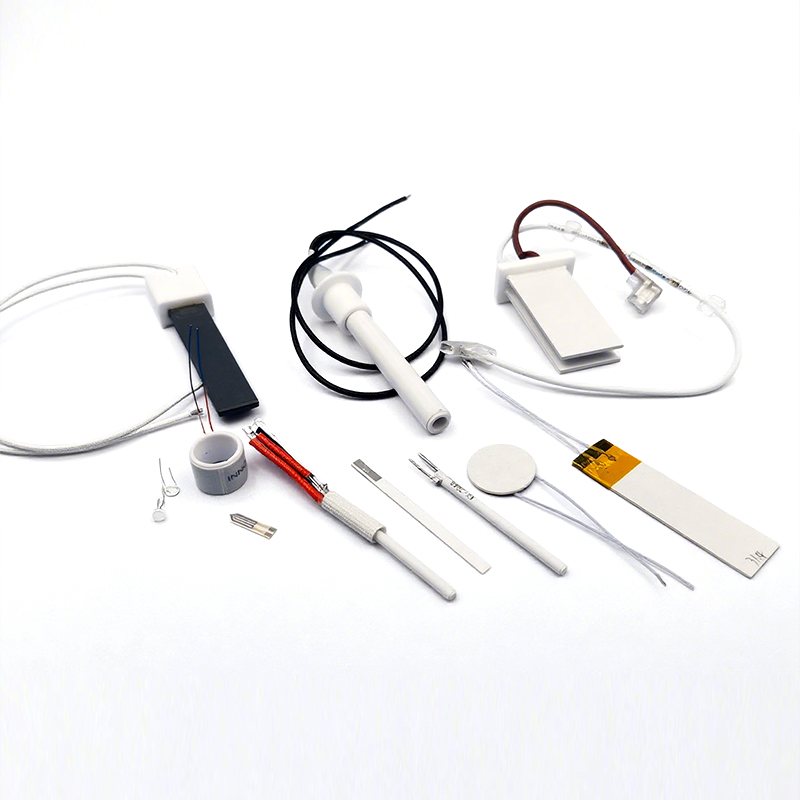
Ceramic-based thermistors and pressure sensors exploit semiconducting oxides (e.g., NiO, CoO, Mn₃O₄) and piezoresistive ceramics to ensure accurate detection in harsh environments.
Examples:
- NTC thermistors: Used in medical devices, lithium battery protection, and HVAC systems.
- Piezoelectric sensors: Used for aerospace engine monitoring, vibration analysis, and structural health diagnostics.
Optical and Photonic Sensors
Transparent ceramics also find use in optical sensing applications.
For example, luminescent ceramics doped with rare-earth elements (e.g., YAG:Ce) are being applied in temperature sensors, biomedical diagnostics, and LED lighting.
5. Manufacturing Innovations Driving New Applications
Advances in processing technologies are expanding the functional capabilities and manufacturability of ceramic materials.
Additive Manufacturing (3D Printing)
Ceramic 3D printing enables complex microstructures for customized optical or electronic components.
Applications include micro-lens arrays, sensor housings, and multifunctional ceramic circuits.
Thin-Film Deposition and Coatings
Techniques like sol–gel processing, atomic layer deposition (ALD), and sputtering allow the creation of ultra-thin ceramic films for microelectronics and MEMS devices.
Nanostructured Ceramics
Nanoceramics exhibit enhanced dielectric and optical properties, with improved grain boundary control leading to higher performance in capacitors and photonic devices.
6. Emerging Trends in Functional Ceramics
(1) Integration with Semiconductors
Functional ceramics are increasingly used as substrates, interposers, and heat spreaders in semiconductor packaging.
AlN and Si₃N₄ substrates enable high thermal dissipation and electrical insulation, critical for GaN and SiC-based power devices.
(2) Flexible and Printable Ceramics
Research is moving toward printable ceramic inks for flexible electronics and wearable sensors, combining ceramic functionality with polymer flexibility.
(3) Smart and Multifunctional Systems
Future ceramics will combine multiple functionalities — for instance, transparent piezoelectric ceramics that act as both optical and pressure sensors, or self-healing oxides for longer device life.
(4) Sustainability and Eco-Design
Recycling of ceramic materials and adoption of low-carbon manufacturing are emerging priorities as part of sustainable electronics development.
7. Market Outlook
According to market analysis, the global functional ceramics market is projected to exceed USD 60 billion by 2030, driven by demand in:
- 5G and high-frequency electronics
- Optoelectronic systems
- Smart sensors and IoT devices
Conclusion
Functional ceramics are no longer niche materials — they are strategic enablers at the intersection of optics, electronics, and sensing technology.
Their ability to withstand extreme environments, deliver precise functionality, and integrate with digital systems positions them as essential materials in the era of smart and sustainable technology.As a dedicated observer of ceramic innovation, Loongeram continues to explore how functional ceramics are shaping the future of advanced materials — where performance, intelligence, and sustainability converge.